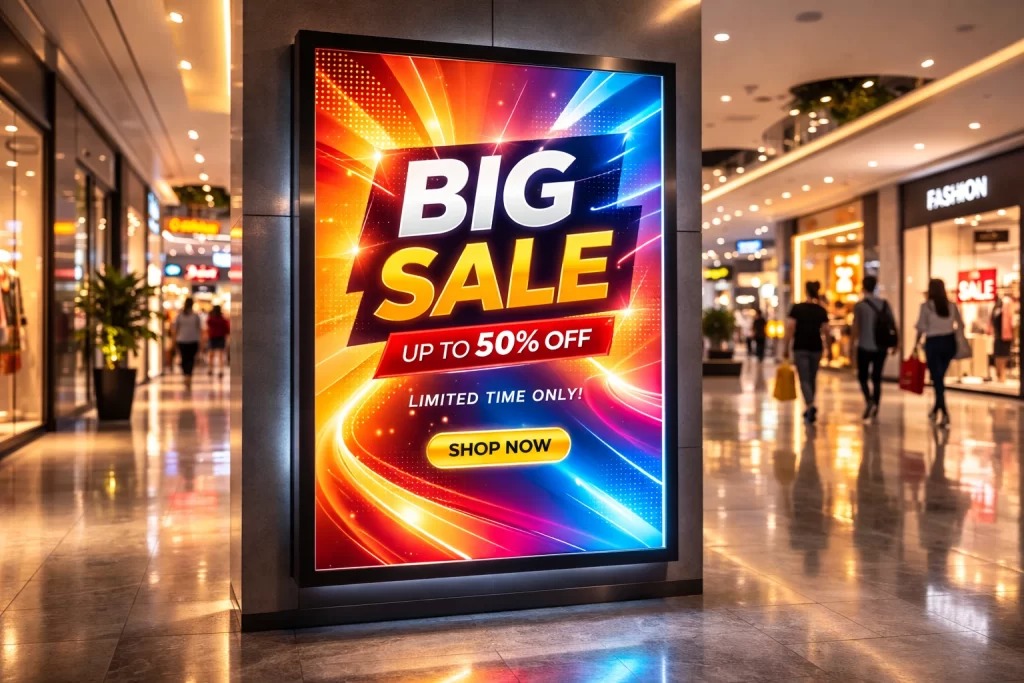
Illuminated graphics have become a defining element in modern visual communication. From retail interiors to exhibitions and commercial environments, light-enhanced displays influence how colour, depth, and detail are perceived. When executed correctly, illuminated visuals deliver sharper contrasts, richer tones, and a dimensional quality that standard prints cannot replicate. This article examines how advanced illuminated printing techniques improve colour accuracy and visual depth while maintaining consistency, durability, and professional presentation across varied display settings.
Light does more than brighten an image—it reshapes how the human eye interprets colour and form. When graphics are illuminated evenly from behind, shadows soften and colours appear more saturated without distortion.
These advantages make illuminated graphics particularly effective for branding, promotions, and informational displays where clarity and impact matter.
The success of illuminated displays depends heavily on the print media used. Poor material choice can lead to patchy brightness, colour shift, or faded imagery. High-quality substrates are designed to diffuse light evenly, preventing hotspots and dull areas.
| Feature | Benefit |
| Uniform opacity | Balanced light diffusion |
| Smooth surface coating | Precise ink placement |
| Heat resistance | Maintains colour stability |
| Dimensional consistency | Prevents warping in frames |
When these characteristics are present, illuminated visuals retain their intended appearance across different lighting conditions.
Depth in illuminated graphics is not accidental—it is engineered through design choices and printing precision. Gradients, shadows, and layered imagery gain a three-dimensional feel when light passes through the print rather than reflecting off it.
When paired with backlit film print, these design techniques create visuals that feel immersive rather than flat, even at close viewing distances.
Colour accuracy is one of the most challenging aspects of illuminated graphics. Light intensity can alter hues if ink formulation and calibration are not carefully managed.
Professional printing processes compensate for these variables, ensuring that brand colours remain consistent whether viewed in daylight or low-light interiors. This level of control is essential for corporate branding and premium retail applications.
Illuminated displays are often installed for extended periods, making durability a critical consideration. Exposure to continuous light and mild heat can degrade inferior materials.
Using backlit film print with appropriate inks and coatings ensures that illuminated graphics maintain their visual integrity long after installation.
Illuminated visuals are versatile and adapt well to multiple environments where visibility and aesthetic quality are essential.
In many of these settings, illuminated panels are integrated with freestanding display structures to create cohesive visual systems that attract attention without overwhelming the space. Solutions such as professionally printed free-standing display units support this integration seamlessly.
Behind every successful illuminated graphic is a carefully managed production workflow. From file preparation to final installation, accuracy at each stage prevents costly errors and reprints.
Many print providers complement their production workflow with digital planning tools similar to a Task Tracker, helping teams coordinate complex projects efficiently without compromising print quality.
As illuminated display projects scale, operational reliability becomes just as important as print quality. Print businesses often rely on external technical support to maintain equipment uptime and data security.
Professional support from it managed service providers London helps printing operations maintain stable systems, protect production data, and support advanced colour management software—ensuring consistent output across multiple illuminated projects without disruption.
Modern illuminated graphics also align with sustainability goals when produced responsibly. Advances in LED lighting and material efficiency reduce energy usage while maintaining brightness and colour precision.
These benefits make illuminated graphics a practical long-term investment rather than a short-term visual solution.
Illuminated graphics combine material science, precise printing, and thoughtful design to produce visuals with exceptional depth and colour accuracy. By controlling light diffusion, ink behaviour, and production consistency, businesses can create displays that remain visually compelling over time. Whether used in retail, exhibitions, or corporate spaces, illuminated prints deliver clarity, durability, and professional impact. When supported by structured workflows, reliable technology infrastructure, and high-quality substrates, illuminated graphics become a dependable communication tool that reinforces brand presence while maintaining visual integrity across diverse environments.
© 2026 Point of Sale Printers. All Rights Reserved.